
Ironing Science : How to Perfectly Master Iron Temperature and Ironing Boards Like a Pro
https://www.aregultion.com/ultimate-guide-to-ironing-mastery-board-hacks/
Preface: Why can’t your shirt be ironed? You’re fighting science.
Imagine this: You’re in a rush to get out the door, giving a last-ditch effort to a wrinkled shirt, leaving two scorch marks . This isn’t just a shaky hand or bad luck; it’s a clash between you and fiber science . Ironing may seem like a simple chore, but at its core lies the delicate interaction of heat, moisture (steam), and fabric fibers .
You might think you can just buy a pricier iron and be done with it, but here’s a bigger secret: your ironing board is also the “laboratory platform” for this science experiment.
Simply adjusting the iron’s temperature isn’t enough. You need to understand how the ironing board ‘s material (breathability) and steam interact to achieve truly professional-grade smoothing results. This article will provide a simple guide to mastering the art of ironing , eliminating ironing frustrations and ensuring your clothes last longer.

1. The Golden Rule of Iron Temperature : The Life and Death Line from Nylon to Cotton and Linen
The first and most crucial step in ironing is to check the label on your garment . If the label is missing, you’ll need to adjust the iron temperature based on the fabric type . Using the wrong temperature can ruin not only your garment but also your ironing board cover .
H3: The heat resistance of the fiber matches the ironing skills
Remember this simple rule: synthetic fibers are the “scarce kids” at the party (they can handle cold temperatures), while natural plant fibers are the “old-school tough guys” (they can handle hot temperatures) .
| Iron Settings | Fabric type (start testing at low temperature) | Key Scientific Ironing Tips |
| Cool (Nylon/Acrylic) | Synthetic fibers (nylon, polyester, acrylic) | Always use a doily (to prevent a shiny melted surface); no steam ; and move quickly and smoothly. |
| Warm (Silk/Wool) | Protein fibers (silk, wool) | Medium to low steam is essential; always iron from the back of the garment ; wool can be left hanging to benefit from the steam. |
| Medium-Hot (Blended) | Blended fabrics (cotton and polyester blends) | Use the right amount of steam ; the temperature should be the lower of the heat resistance of the two fibers , don’t take any risks. |
| Hot (Cotton/Linen) | Plant fibers (cotton, linen, denim) | Maximum steam capacity ; can directly apply greater pressure, using high temperature and moisture to reshape the fiber structure . |
H3: Sunscreen for ironing boards : Why do you need an ironing mat?
Ever notice that awkward “shimmer” or light spot on dark pants after you’ve ironed them? This is the direct impact of heat on the fabric fibers.
Solution: Always place a thin cotton cloth or a specialized ironing mat (also called a pressing cloth) between the garment and the iron . This acts as a thermal buffer, effectively dissipating the heat and preventing hot spots, perfectly preserving the fabric ‘s sheen and color.
2. Steam settings and ironing boards : A perfect storm for a smooth finish
Steam (water vapor) acts as a fiber resetting agent during ironing . It temporarily softens the fibers, making it easier for heat to reshape them. However, the effectiveness of steam depends almost entirely on the breathability of your ironing board .
Take advantage of the breathable mesh of your ironing board : say goodbye to damp wrinkles
A high-quality ironing board should never be a solid board, it must be a metal mesh board .
The science: When you turn on a steam iron , the steam needs to penetrate the garment and dissipate quickly. If your ironing board isn’t breathable (like a cheap wooden board or solid plastic), the steam can accumulate under the garment, forming a condensation that can leave the garment damp after ironing and cause wrinkles to reappear .
Correct way: When using high steam, the breathable grid of the ironing board allows steam to penetrate quickly and remove excess moisture from the bottom, ensuring that clothes remain dry while being flat.
Ironing board ‘s air blower technology (for luxury fabrics)
For delicate fabrics like wool coats or silk skirts, you can’t directly touch the iron . In this case, some high-end ironing boards will be equipped with a blower function :
Blowing Function: The ironing board blows air, creating a cushion beneath the garment. You place the garment on this cushion, and the steam from the iron smooths out wrinkles while it’s suspended in mid-air . This is a professional-grade technique for ironing suits, cashmere, and other items that require a more fluffy feel .
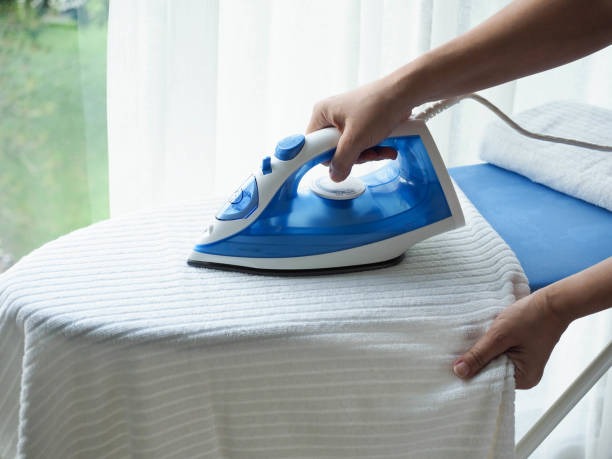
3. Ironing board accessories:
good ironing board is more than just a flat surface; it’s your ironing workstation . Taking advantage of every detail of its design can double your ironing speed and precision.
Using the edge and accessories of the ironing board : details make all the difference
Tip: The tip of the ironing board is a great tool for working with geometric shapes, perfect for ironing shirt collars ( ironing from the tip inward ) and cuffs. Don’t try to do these detail jobs on the main body of the ironing board .
Sleeve Board: This is a small, round mini ironing board that attaches to the side of your ironing board . It’s designed to allow you to iron sleeves without creating an unsightly center crease . If you’re a shirt lover, this accessory is a must-have .
Iron Stand and Cord Clips: Make sure your ironing board has a sturdy, insulated iron stand and use a cord clip to secure the iron ‘s cord to the board. Trust me, preventing the cord from getting tangled or interfering while you iron will make you feel ten times better.
in conclusion:
The next time you’re ready to iron , think of the process as performing a science experiment :
Set the correct temperature (to protect the fibers).
Adjust the amount of steam (to soften the fabric) and take advantage of the breathability of the ironing board (to remove moisture).
Utilize tools and accessories (for precise fiber reshaping).
By using scientific methods, you can make ironing more efficient and extend the life of your clothes. After all, a well-cared-for shirt is worth far more than one that was carelessly thrown into the dryer.
What’s your most common ironing mistake? Do you have an ironing board with a blower function ? Share your ironing tips in the comments!
https://www.aregultion.com/ultimate-guide-to-ironing-mastery-board-hacks/


